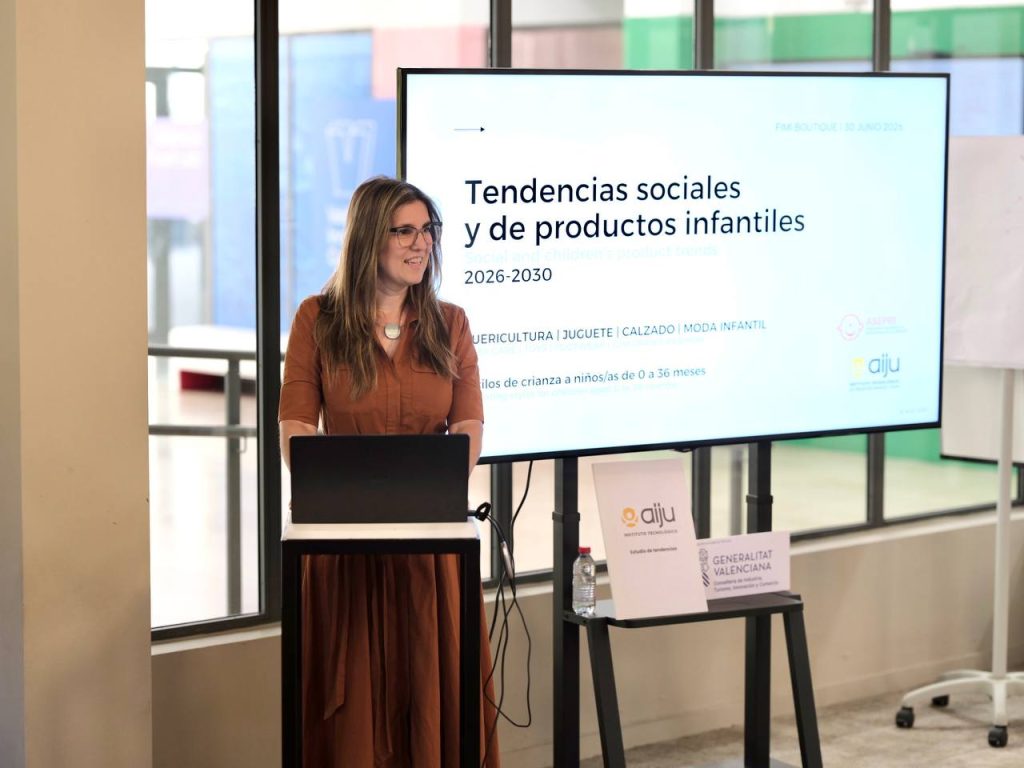
The Spanish Association of Children’s Products (ASEPRI) presented the study “Social and Children’s Product Trends 2026-2030” on Tuesday. The study, prepared by AIJU (Technological Institute for Children’s Products and Leisure), was presented at FIMI Boutique, the industry’s professional event being held at Las Naves until Wednesday, July 1st.
The presentation, part of ASEPRI’s Sector Meeting entitled “New Families, New Rules: How to Lead the Children’s Market (2026-2030),” brought together brands and professionals from the children’s ecosystem interested in anticipating the profound changes transforming parenting and consumption. The presentation was given by Clara Blasco López, Trend and Design Researcher at AIJU.
A Unique Snapshot of Families with Children Aged 0 to 36 Months
The study, owned by ASEPRI and developed by AIJU, offers a strategic vision of the future of the children’s market based on a representative sample of 1,020 Spanish households with children aged 0 to 36 months. The research analyzes how families think, feel, and consume, identifying emerging patterns that will directly impact sectors such as toys, fashion, footwear, and childcare products.
The results point to a paradigm shift in which factors such as sustainability, personal identity, emotional well-being, and social commitment play a central role in purchasing decisions and parenting styles.
New Parenting Profiles: Living in Diversity
The report identifies different parenting profiles that reflect how mothers and fathers relate to their children and that coexist in today’s society. Thus, practical parenting focused on functionality and efficiency is observed alongside respectful models centered on emotional development and attachment; At the same time, approaches such as “my little project,” which involves a strong dedication to the child’s development, or the “snowplow” profile, in which obstacles are removed from the child’s environment, are emerging, as well as styles in which adults seek to maintain their individual identity without giving up parenthood. This diversity shapes a fragmented market that demands more personalized responses from brands.
The study also underscores the influence of lifestyle on family decisions, highlighting how different values and habits condition both the organization of daily life and expectations regarding products. In this sense, “fashionable” or “pet-loving” households, where pets are integrated as another member of the family, coexist with profiles such as “activists,” committed to social or environmental causes, as well as lifestyles focused on waste reduction, health and well-being, or attention to aesthetics and trends. All these approaches directly impact the types of products families demand and how they connect with brands.
Key takeaways for the industry: anticipating change
During the session held at FIMI Boutique, AIJU outlined the report’s main conclusions, offering companies practical tools to adapt to this new context. In this regard, the focus was on the need to redesign product offerings to align with emerging values, connect with families authentically, and invest in innovation in product, design, and communication—key aspects for maintaining competitiveness in a transforming market.
According to Yolanda Aguirre, Head of Communications at ASEPRI, “this study provides a strategic guide for companies that want to lead the children’s market in the coming years, at a time when the rules of parenting—and consumption—are changing profoundly.”